
-
By Code 9 Group
- In Clinical Costing
Clinical Costing: Improving Healthcare Financial Efficiency and Transparency
Healthcare organizations today face increasing pressure to deliver high-quality patient care while maintaining financial sustainability and operational efficiency. Rising treatment costs, advanced medical technologies, and growing patient expectations have made financial management more complex than ever before. In this evolving healthcare environment, clinical costing has emerged as a powerful solution that enables hospitals and medical institutions to understand the true cost of healthcare delivery. By providing accurate financial insights into clinical activities, clinical costing supports better decision-making, improved resource utilization, and long-term organizational growth.
Clinical costing goes beyond traditional accounting methods by linking financial data directly with clinical services and patient care activities. It allows healthcare providers to evaluate how resources are consumed during treatments, procedures, and patient journeys. This detailed understanding helps organizations reduce inefficiencies, enhance operational performance, and confirm that financial planning aligns with clinical outcomes. As healthcare systems continue to shift toward value-based care models, clinical costing plays a vital role in balancing quality services with cost control.
Clinical Costing in Healthcare
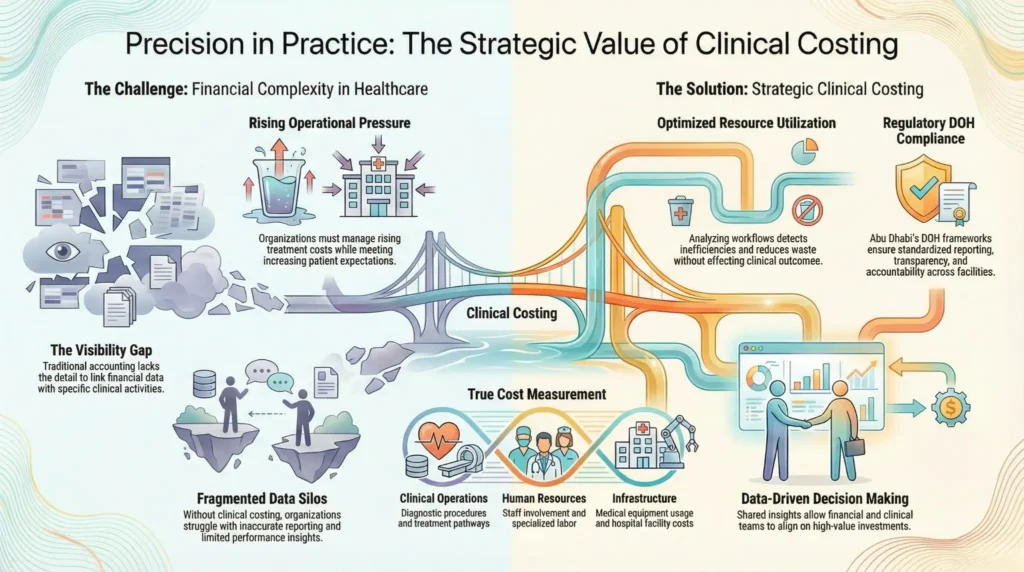
Clinical costing refers to the systematic process of identifying, measuring, and allocating costs associated with healthcare services provided to patients. Unlike general financial accounting, clinical costing focuses specifically on clinical operations, including diagnostic procedures, treatment pathways, staff involvement, medical equipment usage, and hospital infrastructure costs. This approach allows healthcare organizations to gain accurate visibility into how much each service or procedure truly costs.
Healthcare providers rely on clinical costing to create transparency across departments and service lines. By collecting and analyzing financial and clinical data together, hospitals can identify high-cost areas, monitor performance, and improve operational planning. Accurate costing data also helps leadership teams make informed decisions regarding staffing, service expansion, and investment strategies. Without proper clinical costing systems, organizations may struggle with budget inefficiencies, inaccurate financial reporting, and limited insight into operational performance.
Importance of Clinical Costing for Healthcare Organizations
The importance of clinical costing has increased significantly as healthcare providers aim to achieve financial sustainability without compromising patient outcomes. Hospitals must carefully manage expenses while maintaining compliance with healthcare regulations and delivering high-quality services. Clinical costing provides the data foundation required to achieve this balance. One of the key advantages of clinical costing is improved financial planning. Healthcare organizations can forecast expenses more accurately by understanding historical cost patterns and treatment expenses. This allows management teams to allocate budgets effectively and avoid unexpected financial challenges. Additionally, clinical costing supports performance benchmarking, enabling organizations to compare costs across departments and identify opportunities for improvement. Another major benefit is cost optimization. By analyzing clinical workflows and treatment costs, healthcare providers can detect inefficiencies, reduce waste, and streamline processes. This leads to better operational efficiency and improved patient experiences. Clinical costing also supports pricing strategies and reimbursement negotiations by providing evidence-based cost data, confirming fair and sustainable financial models.
Clinical Costing Abu Dhabi: Supporting Healthcare Transformation
The adoption of clinical costing Abu Dhabi solutions has grown rapidly as healthcare providers focus on modernization, regulatory compliance, and financial transparency. Abu Dhabi’s healthcare sector continues to evolve with advanced technologies and performance-based healthcare models, making accurate cost management a necessity rather than an option. Healthcare organizations in Abu Dhabi are increasingly implementing structured clinical costing frameworks to monitor treatment expenses, analyze departmental efficiency, and improve operational planning. These systems allow hospitals to track costs at a detailed level, including patient episodes, medical procedures, and resource utilization. As a result, healthcare leaders gain valuable insights into service profitability and operational performance. Clinical costing Abu Dhabi initiatives also support healthcare transformation programs aimed at improving efficiency and accountability across the sector. By adopting standardized costing practices, hospitals can align financial operations with regulatory expectations while enhancing transparency in healthcare spending. This not only improves internal management but also strengthens trust among investors, including patients, regulators, and healthcare partners.
Clinical Costing DOH Compliance and Regulatory Alignment
Compliance with clinical costing DOH guidelines is an essential requirement for healthcare providers operating within regulated healthcare environments. The Department of Health (DOH) promotes standardized clinical costing methodologies to confirm consistency, accountability, and transparency across healthcare facilities. Clinical costing DOH frameworks encourage healthcare organizations to adopt structured cost allocation methods and standardized reporting practices. These guidelines help create uniform financial data that can be used for benchmarking, policy development, and healthcare system improvement. By following DOH clinical costing standards, hospitals can demonstrate compliance while improving internal governance and financial control. Regulatory alignment also enhances data accuracy and reliability. When healthcare providers implement DOH-aligned costing systems, they can produce detailed financial reports that support audits, performance reviews, and strategic planning. This level of transparency supports organizational credibility and helps healthcare institutions meet regulatory expectations efficiently.
How Clinical Costing Improves Decision-Making and Patient Care
Clinical costing is not only a financial tool but also a strategic resource that directly contributes to better healthcare outcomes. By understanding the cost and efficiency of clinical services, healthcare leaders can make informed decisions that improve both operational performance and patient care quality. Accurate costing data allows organizations to evaluate treatment pathways and identify areas where resources can be optimized without affecting clinical outcomes. Hospitals can redesign workflows, improve service delivery, and invest in high-value medical services that benefit patients the most. This data-driven approach confirms that financial decisions support clinical excellence rather than restrict it. Clinical costing also improves collaboration between financial and clinical teams. Doctors, administrators, and financial managers can work together using shared data insights to improve efficiency and patient experiences. When clinical and financial objectives align, healthcare organizations achieve stronger performance and sustainable growth.
The Future of Clinical Costing in Healthcare
As healthcare systems continue to digitalize and adopt advanced analytics, clinical costing will become even more important. Emerging technologies such as data integration platforms, automation tools, and predictive analytics are transforming how healthcare organizations manage financial information. These innovations allow clinical costing systems to provide real-time insights, helping organizations respond quickly to operational challenges. The future of healthcare depends on transparency, efficiency, and value-based care, all of which are supported by strong clinical costing practices. Healthcare providers that invest in modern costing systems will be better prepared to manage financial pressures, meet regulatory requirements, and deliver high-quality patient services.
Conclusion
Clinical costing has become a fundamental pillar of effective healthcare management, enabling organizations to understand the true cost of patient care while improving operational efficiency and financial transparency. Through structured costing systems, healthcare providers can improve budgeting accuracy, optimize resources, and support strategic decision-making. The growing implementation of clinical costing Abu Dhabi solutions and adherence to clinical costing DOH standards demonstrate the increasing importance of standardized financial practices in modern healthcare. By adopting comprehensive clinical costing frameworks, healthcare organizations can achieve sustainable growth, regulatory compliance, and improved patient outcomes while maintaining strong financial performance in an evolving healthcare landscape.